
For more than a decade, electric aircraft taxiing (e-taxi) has hovered between a promising idea and an unrealised product.
Safran, L-3 and Honeywell proved the concept in 2012 with an A320 demonstration in Paris. WheelTug has promoted a nose-wheel motor since 2010. Yet none has reached FAA certification, and no airline has been able to adopt a system at scale.
Green Taxi Aerospace believes it can finally break that cycle.
Safran and Honeywell’s Electric Green Taxiing System (EGTS) showed more than ten years ago that main-engine-off taxiing was viable. An A320 testbed performed repeated pushbacks and taxi runs at the 2013 Paris Air Show with its engine covers fitted, powered entirely by APU-driven wheel motors.

On paper, the benefits were enormous. EGTS materials suggested taxi fuel burn could fall by around one-sixth, with CO₂ emissions during taxi reduced by more than half. But the system weighed 450–1,000 lb, depending on configuration, and required extensive additions to the landing gear, power system and cooling architecture.
The certification path and retrofit business case became increasingly difficult to justify. By 2016, the joint venture was wound down. Safran Landing Systems (SLS) continues to refine its product for the line-fit market, but is some way off from having a production-ready solution.
WheelTug’s nose-wheel approach faced different but equally stubborn barriers. The company secured FAA acceptance of its certification plans for the 737NG in 2017, and has said for years it is in the “final stages” of certification. But, as of 2025, no system is in commercial service.
Speaking to AGN on the sidelines of the World Aviation Festival, the CEO of rival company Green Taxi, David Valaer, avoids criticising competitors, but highlights the engineering realities.
“When we land and take off, it’s got to be all the way disengaged. The motor will not like going 150 knots on touchdown,” he says.

Packing a motor into the nose wheel — an area with tight structural margins, limited cooling and strict size constraints — only amplifies the challenge. “I’m not saying it can’t be done, but it’s not making great progress,” he adds diplomatically.
Academic and industry reviews echo that assessment: system weight, landing-gear harshness and the certification burden of touching multiple safety-critical interfaces have derailed previous efforts. The issue was never whether electric taxiing worked; it was whether it could be made light enough, robust enough and certifiable enough for airlines to adopt.
Read more: How electric taxiing could cut emissions faster than SAF
Green Taxi is taking a different path: a retrofit main-gear system and a certification-first development strategy.
Main-gear drives allow higher torque, better traction and higher taxi speeds because they use the aircraft’s load-bearing wheels rather than the smaller, lighter nose gear. Studies by NASA and others show they experience less heat loading and mechanical shock, simplifying cooling and improving durability.
“It’s a very complicated project,” Valaer says. “We touch the APU, we touch the landing gear, we touch the pilot control system. Certification will be far harder than many early e-taxi startups anticipated.”
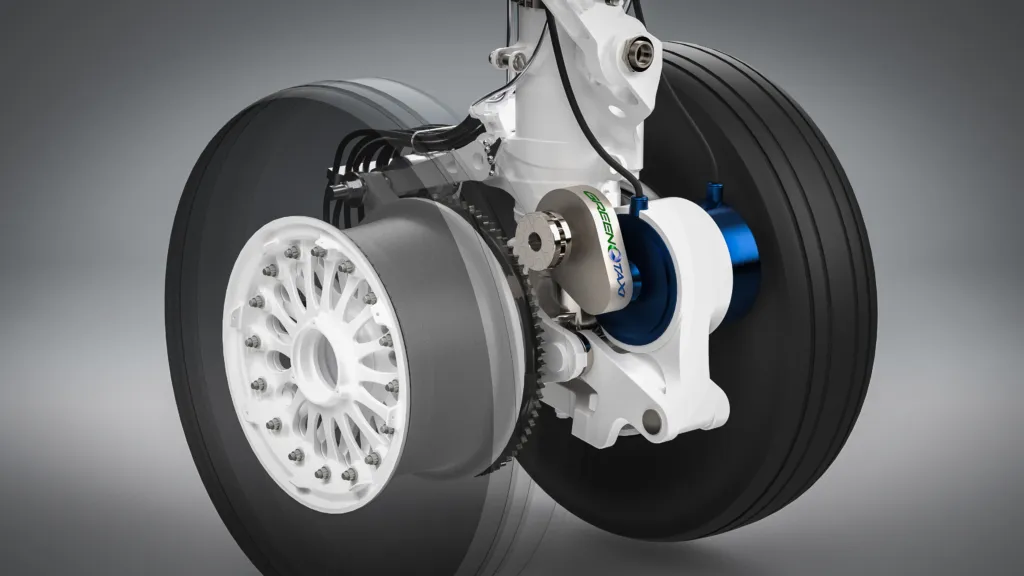
The company’s leadership has completed 25 supplemental type certificates (STCs) across previous aerospace ventures, many involving complex electrical and structural integrations. That experience shapes the programme’s sequencing.
Instead of flying prototypes and then trying to retrofit certification around them, a pattern that slowed earlier efforts, Green Taxi is building its certification plan first.
Any system modifying APU power distribution, landing-gear loads, cockpit controls or brake-system interfaces must demonstrate compliance with a wide suite of regulations: Part 25.1309 for system safety, DO-160 for environmental testing, DO-178C and DO-254 for software and hardware assurance, Part 25.729 for gear-retraction effects, and extensive human-factors requirements. The full compliance matrix runs to hundreds of pages, and Green Taxi is tackling it before hardware fabrication.
“We’re not going to cut metal until our data is approved by the FAA,” Valaer says. “Ultimately, any green taxi, e-taxi, or electric taxi will only occur if it gets FAA certification.”
Safran remains committed to electric taxiing, but only as a forward-fit option for future aircraft. While technically elegant, line-fit adoption alone would take decades to influence global emissions. With fewer than 2,000 new commercial aircraft delivered each year into a fleet exceeding 28,000, the vast majority of flying will continue to be done by mid-life aircraft well into the 2030s and beyond.
This makes retrofit solutions the true near-term opportunity for decarbonisation. Aircraft like the E-Jets, A320s and 737s perform the highest daily cycle counts and burn the most fuel on the ground.
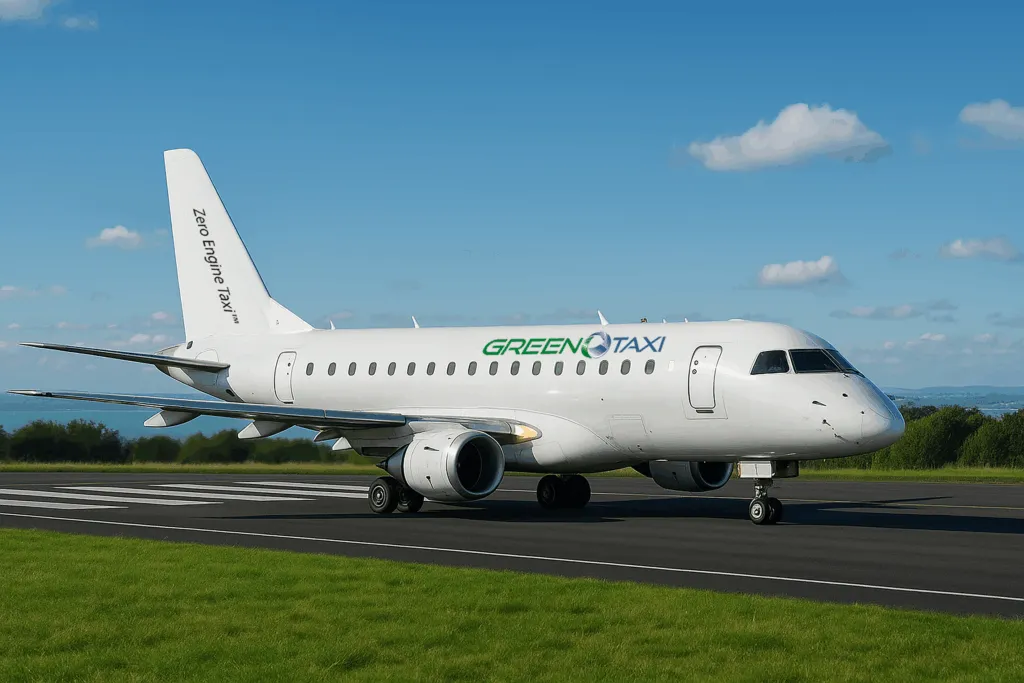
“We support them in that,” Valaer says of Safran’s OEM strategy, “but we’re going to do a retrofit solution,” starting with the Embraer E170/175. Its high utilisation means fuel- and emissions-savings compound rapidly.
Because the system is non-flight-critical, airlines retain full dispatch reliability. “If anything fails, the aircraft simply reverts to standard engine taxiing,” Valaer notes. No new MEL constraints, no crew certification burden; a major adoption enabler.
One of Green Taxi’s strongest assets is its unusually deep airline and MRO involvement. Earlier e-taxi efforts developed largely in isolation, but this programme is being shaped from day one by the operators who will fly it.
Delta Air Lines has brought Green Taxi into its Sustainable Skies Lab, giving the team access to engineering data, taxi profiles, procedures and real-world constraints. SkyWest has taken an even more hands-on role — when Green Taxi needed detailed wheel-assembly data, SkyWest shipped a complete Embraer 175 wheel for analysis.
“The support we have has been amazing,” Valaer says.

Embraer is involved through a three-way technical partnership with Delta and Green Taxi. MHIRJ, steward of the CRJ fleet, has expressed interest due to the CRJ’s exceptionally high daily utilisation. Horizon Air and other regionals have provided operational and human-factors input ranging from pilot workflow to ground-handling constraints.
This kind of cross-functional certification ecosystem is extremely rare for an STC project. It reduces the risk of late-stage surprises — brake-cooling issues, high-incline taxiway behaviour, ground-handling limits, stand-layout incompatibilities — that have derailed previous innovations. It also strengthens the business case: airlines themselves are validating the operational gains and fuel savings, not just the manufacturer.
Green Taxi is now entering the heavy technical phase, leading toward certification. The company plans to finalise its full certification plan with the FAA this year.
“You have to get a detailed cert plan done,” Valaer says. Only once the FAA approves that data will hardware fabrication begin. “We’re not going to cut metal until our data is approved by the FAA,” he emphasises.
The next major milestone is the production of a conforming prototype in late 2026, the first system built entirely to certified design standards. It will undergo taxi testing, with flight testing added only if required by the FAA. This supports a potential STC in 2027, an ambitious but plausible timeline for a system that touches multiple aircraft interfaces.

Meanwhile, the type-coverage roadmap is expanding. The E170/175 comes first, but MHIRJ has opened discussions for the CRJ family, Boeing has expressed interest in the 737, and the A220 and A320 families are under early study.
Market forces appear aligned. More than 60% of the global fleet will remain in service into the late 2030s, meaning retrofit technologies are essential for near-term emissions reduction. Regulators increasingly emphasise operational efficiency improvements, and airlines have begun naming electric taxiing in their sustainability frameworks.
“It’s a very complicated project,” Valaer says. “But if you look at the path — Delta, SkyWest, Embraer, MHIRJ — everybody wants this to happen.”
If the milestones hold, the first commercial aircraft could be taxiing with engines off before the end of the decade, bringing electric taxiing out of the demonstration era and into operational reality.

We are an international airline branding and public relations studio focused on driving our clients’ profile, engagement, and stakeholder ROI by reimagining the roles of design and experience across all platforms.
Stay current:
Sign up for our latest updates.


