
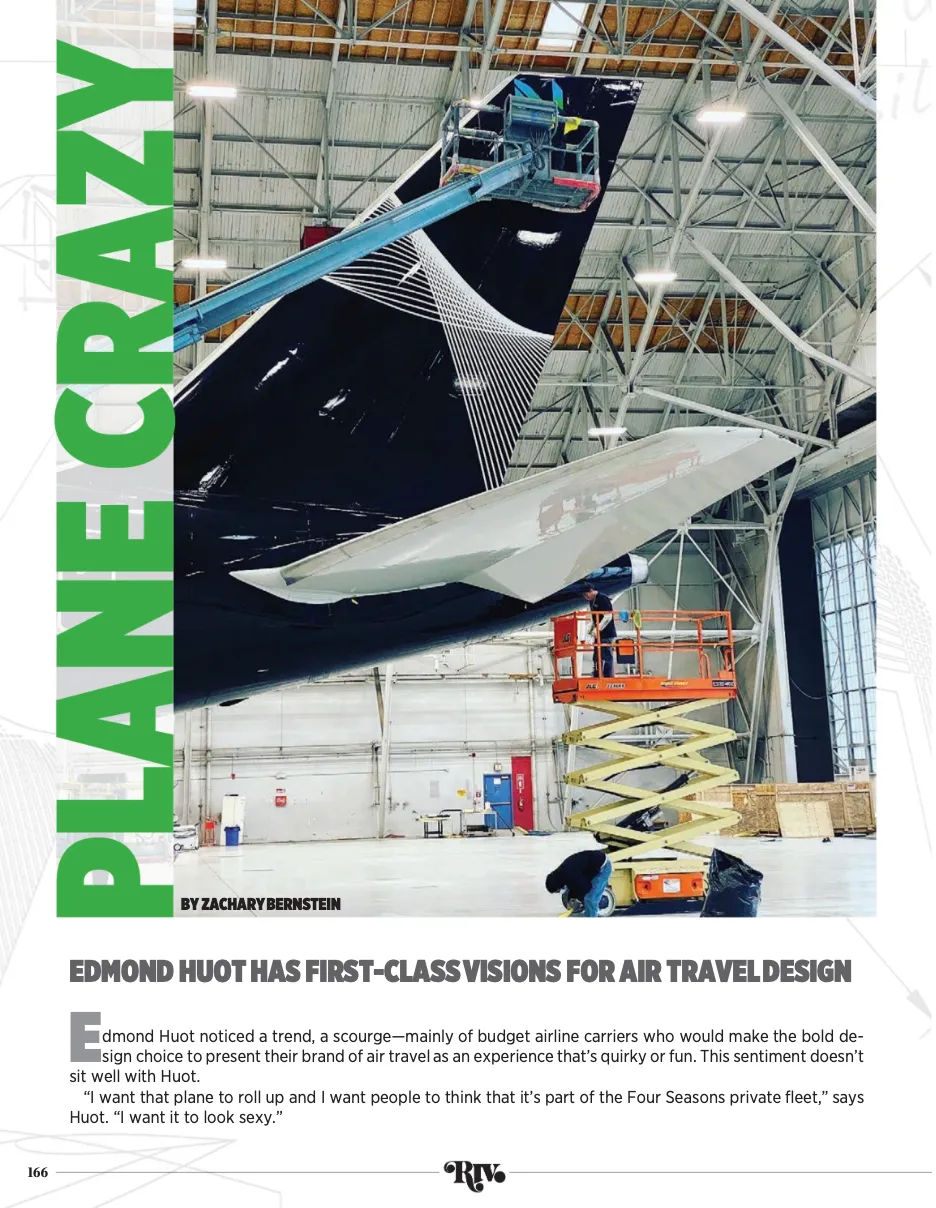
Edmond Huot noticed a trend, a scourge—mainly of budget airline carriers who would make the bold design choice to present their brand of air travel as an experience that’s quirky or fun. This sentiment doesn’t sit well with Huot.
“I want that plane to roll up and I want people to think that it’s part of the Four Seasons private fleet,” says Huot. “I want it to look sexy.”
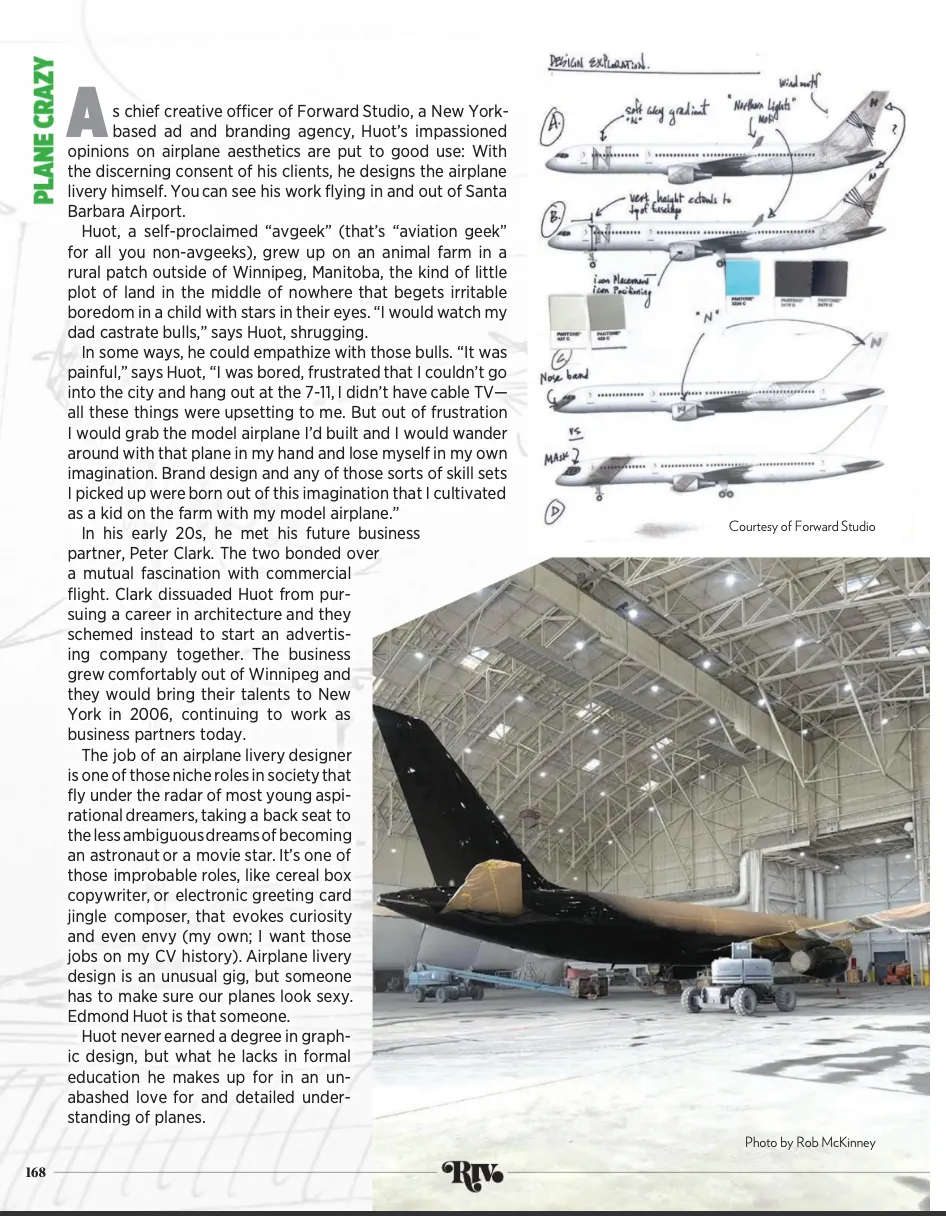
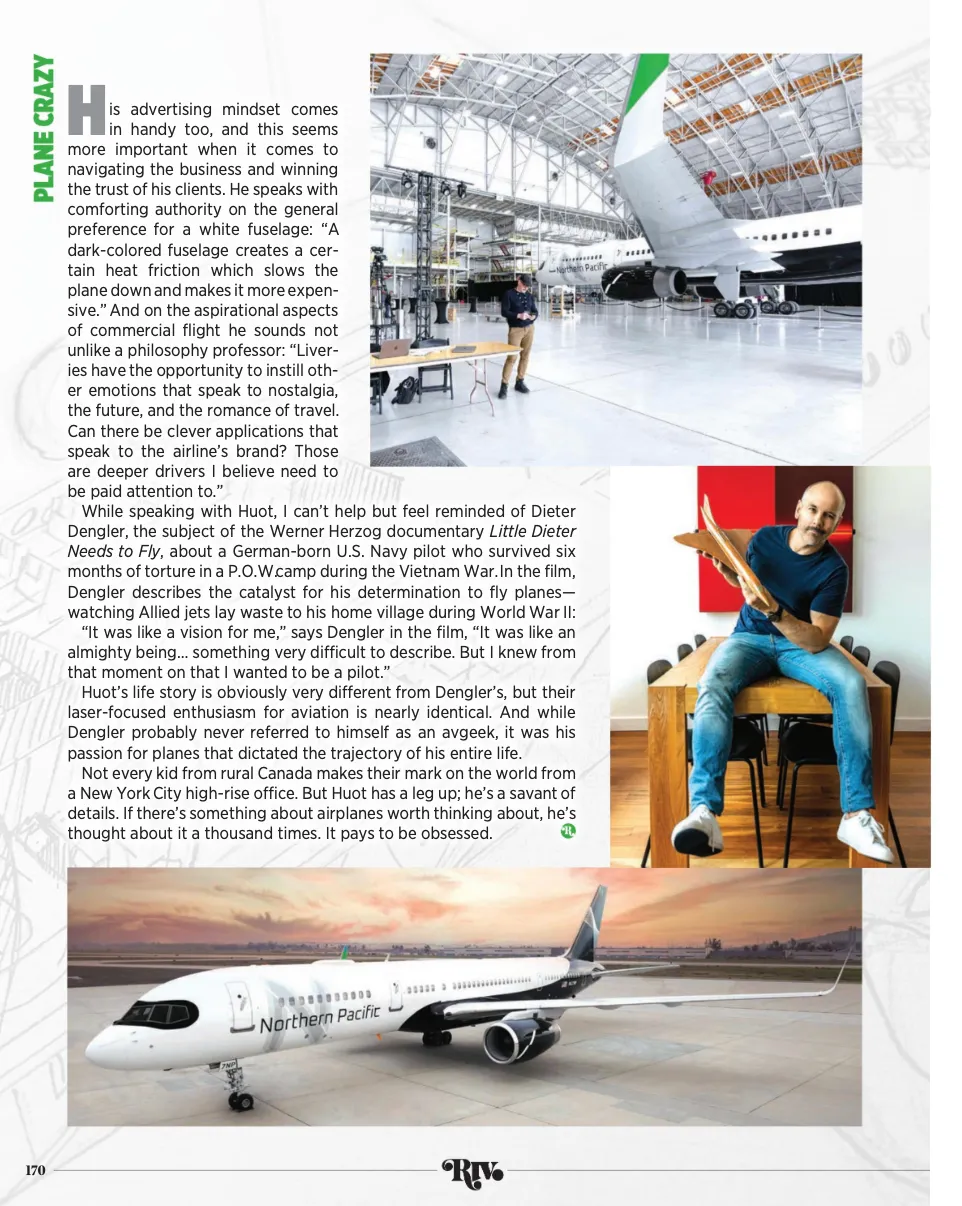
As chief creative officer of Forward Studio, a New York–based ad and branding agency, Huot’s impassioned opinions on airplane aesthetics are put to good use. With the discerning consent of his clients, he designs the airplane livery himself. You can see his work flying in and out of Santa Barbara Airport.
Huot, a self-proclaimed “avgeek” (that’s “aviation geek” for all you non-avgeeks), grew up on an animal farm in a rural patch outside of Winnipeg, Manitoba, the kind of little plot of land in the middle of nowhere that begets irritable boredom in a child with stars in their eyes. “I would watch my dad castrate bulls,” says Huot, shrugging.
In some ways, he could empathize with those bulls. “It was painful,” says Huot, “I was bored, frustrated that I couldn’t go into the city and hang out at the 7-11, I didn’t have cable TV—all these things were upsetting to me. But out of frustration I would grab the model airplane I’d built and I would wander around with that plane in my hand and lose myself in my own imagination. Brand design and any of those sorts of skill sets I picked up were born out of this imagination that I cultivated as a kid on the farm with my model airplane.”
In his early 20s, he met his future business partner, Peter Clark. The two bonded over a mutual fascination with commercial flight. Clark dissuaded Huot from pursuing a career in architecture and they schemed instead to start an advertising company together. The business grew comfortably out of Winnipeg and they would bring their talents to New York in 2006, continuing to work as business partners today.
The job of an airplane livery designer is one of those niche roles in society that fly under the radar of most young aspirational dreamers, taking a back seat to the less ambiguous dreams of becoming an astronaut or a movie star. It’s one of those improbable roles, like cereal box copywriter, or electronic greeting card jingle composer, that evokes curiosity and even envy (my own; I want those jobs on my CV history). Airplane livery design is an unusual gig, but someone has to make sure our planes look sexy. Edmond Huot is that someone.
Huot never earned a degree in graphic design, but what he lacks in formal education he makes up for in an unabashed love for and detailed understanding of planes.
His advertising mindset comes in handy too, and this seems more important when it comes to navigating the business and winning the trust of his clients. He speaks with comforting authority on the general preference for a white fuselage: “A dark-colored fuselage creates a certain heat friction which slows the plane down and makes it more expensive.” And on the aspirational aspects of commercial flight he sounds not unlike a philosophy professor: “Liveries have the opportunity to instill other emotions that speak to nostalgia, the future, and the romance of travel. Can there be clever applications that speak to the airline’s brand? Those are deeper drivers I believe need to be paid attention to.”
While speaking with Huot, I can’t help but feel reminded of Dieter Dengler, the subject of the Werner Herzog documentary Little Dieter Needs To Fly, about a German-born U.S. Navy pilot who survived six months of torture in a P.O.W. camp during the Vietnam War. In the film, Dengler describes the catalyst for his determination to fly planes—watching Allied jets lay waste to his home village during World War II: “It was like a vision for me,” says Dengler in the film. “It was like an almighty being… something very difficult to describe. But I knew from that moment on that I wanted to be a pilot.”
Huot’s life story is obviously very different from Dengler’s, but their laser-focused enthusiasm for aviation is nearly identical. And while Dengler probably never referred to himself as an avgeek, it was his passion for planes that dictated the trajectory of his entire life.
Not every kid from rural Canada makes their mark on the world from a New York City high-rise office. But Huot has a leg up; he’s a savant of details. If there’s something about airplanes worth thinking about, he’s thought about it a thousand times. It pays to be obsessed.

We are an international airline branding and public relations studio focused on driving our clients’ profile, engagement, and stakeholder ROI by reimagining the roles of design and experience across all platforms.
Stay current:
Sign up for our latest updates.


